Impedance
This section details the Impedance model. It supports numerical and symbolic parameters, allowing flexible representation of coupled phase interactions and frequency-dependent characteristics.
Mathematical modeling
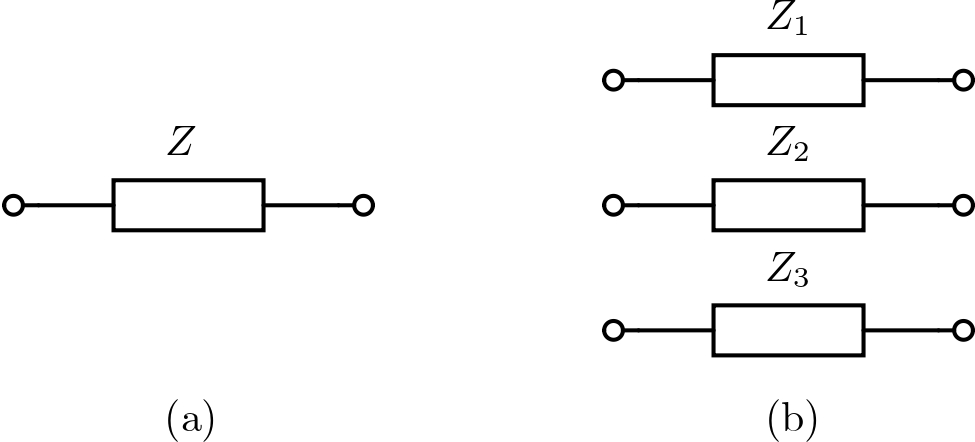
Impedance is created as a series impedance model as shown in Figure 1. Impedance values can be given symbolically (dependent on angular frequency) and as a specific value.
Y-parameter formulation
For the impedance, Y parameters are calculated as:
\[\begin{equation} \label{eq:1} Y = \begin{bmatrix} \operatorname{diag}\!\left\{\frac{1}{Z_{i}} \right\} & -\operatorname{diag}\!\left\{\frac{1}{Z_{i}} \right\} \\ -\operatorname{diag}\!\left\{\frac{1}{Z_{i}} \right\} & \operatorname{diag}\!\left\{\frac{1}{Z_{i}} \right\} \end{bmatrix}, \quad i \in \{1, \ldots, n\}, \end{equation}\]
In (\(\ref{eq:1}\)), \(n\) is the number of phases. The Y matrix is diagonal because mutual coupling between phases is neglected.
Code Explanation
For detailed code information, see the Harmony manual.